

This post is part of the Hacking SaaS Sales Financial Teardown series. If you’re new here, check out the Start Here page.
Happy New Year. Hope everyone had a solid break and is ready to get after it in 2026.
We’re picking the series back up by breaking down Target’s P&L→ POV then showing how to position Samsara as if we were selling into the account.
If this is your first teardown, I’d recommend referencing earlier discussions on the difference between running a business vs selling in it, and financial messaging framework.
The core question we’re looking to answer:
How would a CFO look at this?
Read the business engine → translate the financial reality → strategic priority → build the narrative → distill to persona level value
Financial Teardown # 3: Target
For consistency, I’m referencing Target’s 2024 10-K (fiscal ends on Feb 1).
If this were an active deal, I’d also review the latest earnings calls and Q3 10-Q, and watch for the 2025 10-K expected in early March.
The Business Engine
Target operates as a single reporting segment under a mass-merchandising model. The business is comprised of nearly 2,000 stores, with digital channels ( target.com and mobile app) fully integrated into the core retail operation.
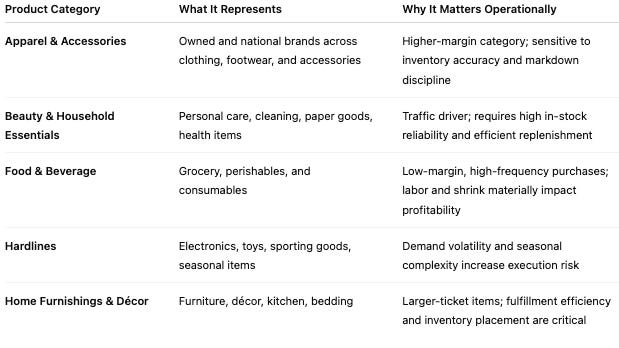
Takeaways:
P&L accountability is centralized at the enterprise level across all activity - stores, digital, fulfillment
The business is organized internally by major merchandise categories for planning and execution
This implies category leaders feel operational pressure but do not own standalone P&Ls or set mandates
Margin performance depends on execution consistency, not portfolio optimization.
For sellers, this distinction matters:
Category leaders → strong internal champions
Enterprise leadership → economic decision makers
This explains why the financial pressure Target feels isn’t about driving demand. It’s about running the machine more efficiently.
How Does the Business Make Money?
When you think of Target, it’s easy to think “retail store”.
But really, Target is a mass scale discovery and fulfillment platform for affordable, trend-driven consumer goods.
Every part of the business supports that capability at national scale:
Physical Stores: “Discover and buy now”
~2,000 locations for everyday needs and impulse purchases.Owned & Exclusive Brands: “Differentiate and protect margin”
Private labels and collaborations reinforce Target’s style-at-scale platform.Digital Channels (App + Website): “Shop anywhere”
A single interface for browsing, purchasing, loyalty, and fulfillment.Same-Day Fulfillment (Drive Up, Pickup, Delivery): “Get it fast”
Stores double as local fulfillment nodes from a shared inventory pool.
Loyalty & Personalization (Target Circle): “Come back more often”
Drive repeat visits without friction or tiering.
Target is an integrated retail ecosystem built for convenience, discovery, and repeat behavior. Business success is driven by habit and ease.
(Target does this well. If you’ve ever gone to Target for “one thing” with your partner and leave with a full cart after an hour - you get it. IFYKYK)
The Financial Signal
Topline
Net sales performance
Comparable sales (traffic + execution)
Digital and same-day sales growth
Takeaway: Growth is driven by traffic and execution, not category expansion
Profitability
Gross margin rate
Operating income and operating margin
Diluted EPS
Takeaway: Margin pressure is constant; profitability depends on cost discipline while maintaining value perception.
Efficiency
SG&A expense rate
Labor productivity
Inventory turnover
Takeaway: Efficiency is the primary lever management uses to protect margin in a low-growth environment. This is the link between margins and AI investments.
Cash Flow
Operating cash flow
Free cash flow
Capital expenditure
Takeaway: Growth investments must be funded internally through disciplined operations and capital efficiency, reinforced by leadership’s focus on ROIC.
Synthesis:
Something I find really interesting is this: Target looks like a retail business. But when you step back and look at how the the P&L actually behaves, it’s really an efficiency business. Labor productivity, margin discipline, and execution consistency do the heavy lifting. That’s the real story in the P&L and where I’d start forming my POV.
The Strategy that Matters to Leaders
What the CFO Cares Most About
Enterprise cost optimization by simplify operations and reduce complexity
Margin recovery to control inventory, reduce shrink, and tighten pricing discipline
Fulfillment economics, lower cost per order across stores and last-mile delivery
Capital discipline, invest in store expansion, supply chain, and tech while protecting cash flow and ROIC
CFO Mandate: Make Target structurally more efficient by funding reinvestment through execution discipline and capital efficiency, not top-line growth.
This is reinforced by a multi-year $2-3 billion cost saving program alongside $4-5 billion in annual CapEx.
What the Company Is Focused On
Merchandising authority, strengthening owned and exclusive brands
Guest experience by improving consistency in stores, in-stock, and service
Deepen omnichannel and same-day fulfillment across stores and digital
Apply AI to merchandising, supply chain, and personalization
Store expansion, new store locations and remodeling to support shopping and fulfillment
Strategic Initiative: Reinforce Target’s differentiated omnichannel position while redesigning the operating model to run leaner and faster at scale.
What’s Getting in Their Way
Softening traffic and comparable sales declines, less people means less sales
Persistent margin pressure from promotions, markdowns, shrink, and fulfillment
Intensifying competition from Walmart, Amazon, Costco, and other value chains
Organizational complexity and speed and too many layers slow decision-making
High cost of transformation because of CapEx and constrained growth
Labor disputes and legal exposure add risk and distraction.
Challenges: Target must execute a large-scale efficiency transformation while protecting the guest experience without the cushion of strong top-line growth.
The Sales Translation
If I were selling Samsara, I’m not pitching “fleet management” or “telematics”.
I’m helping Target build a physical operations execution layer that reduces labor, lowers cost per delivery, and removes variability across its store-fed supply chain—so margin and cash flow improve without adding headcount.
Target may look like a retail business, but the P&L tells a different story. This is an efficiency business, and Samsara helps leadership control the physical systems that make or break execution at scale.
Value Pillars:
Reduce labor tied to physical operations oversight
Lower cost per delivery and asset utilization
Stabilize execution feeding stores
Turn physical operations into measurable performance
Protect margin and cash flow without adding headcount
Example narrative:
Companies like Target are under pressure to restore profitable growth while protecting margins and cash flow—forcing leadership to confront inefficiencies in cost control and execution across supply chain and operations.Samsara makes those drivers measurable and controllable by turning physical operations into enforceable performance inputs, helping reduce costs, stabilize execution, and improve margin and cash flow without adding headcount.
What company should I teardown next?
DM me or email andrew@hackingsales.xyz if you have a suggestion. Subscribers are prioritized and all details are kept anonymous.
As always, thanks for reading and see you all next week.
-Andrew K
PS - if you liked this article, feel free to give a “like”, “comment”, or “share” with your network
Thanks Nueral. I’ve been having a ton of fun and finding it fascinating how once you learn these businesses and stripping down the mechanics to its simplest form - it really helps to hone in on the “how” and “why” your product/service can help
Appreciate the comment!