

This post is part of the Hacking SaaS Sales Financial Teardown series. If you’re new here, check out the Start Here page.
Today we’re breaking down the Coinbase P&L→ POV then showing I’d position Grafana as if we were selling into the account.
This isn’t a crypto thesis. It’s a business teardown on how a complex, regulated platform behaves financially, and how a CFO would look at it.
If this is your first teardown, I’d recommend referencing earlier discussions on the difference between running a business vs selling in it, and financial messaging framework.
The core question we’re looking to answer:
How would a CFO look at this?
Read the business engine → translate the financial reality → strategic priority → build the narrative → distill to persona level value
Financial Teardown # 4: Coinbase
For consistency, I’m referencing the Coinbase 2025 10-K (fiscal ends on Dec 31).
If this were an active deal, I’d also review the latest earnings calls and Q3 10-Q, and watch for the 2026 10-K expected on February 13th.
Note that all outputs are from ChatAE (affiliate link).
The Business Engine
Coinbase reports as a single reportable segment, but economic accountability flows through customer cohorts and the platform surfaces that serve them.
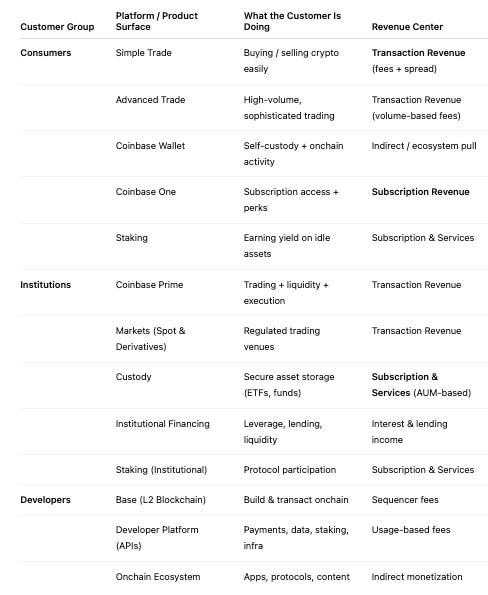
Takeaways:
Although reporting is centralized, P&L accountability lives at the customer and product level. This is most likely where budget decisions are made and where sellers should anchor their narrative.
Coinbase is highly cycle-sensitive:
Trading volatility can drive high-margin revenue, but it’s unpredictable.
Subscription and services revenue is steadier, but requires upfront investment.
Infrastructure bets are long-term ROI plays that pressure near-term margins.
Diversification helps at the platform level, but leadership is actively shifting the mix from volatile transaction revenue toward more predictable, recurring services.
Cost discipline matters here more than at most “growth” tech companies.
How Does the Business Make Money?
Coinbase is not just a “crypto exchange” company. It’s a regulated crypto infrastructure and access platform.
Every part of the platform reinforces this capability across customer segments:
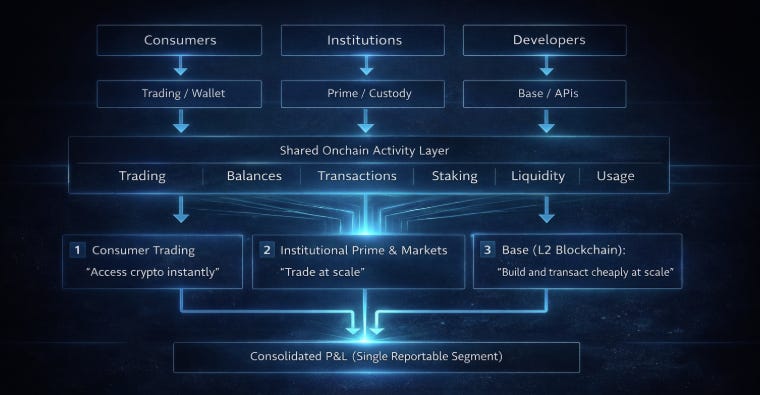
Their mission statement focuses on trust and ease of use which carries through their core customers and revenue drivers:
Consumer Trading “Access crypto instantly”
Transaction fees and spreads. Primary monetization engine in active markets.
Institutional Prime & Markets “Trade at scale”
Lower margin, higher trust, long-term capital markets credibility.
Base (L2 Blockchain) “Build cheaply at scale”
Sequencer fees today, infrastructure leverage tomorrow.
The Financial Signal
Growth is driven by market activity and participation, not linear customer expansion.
Topline
Total net revenue
Transactional revenue
Trading volume + MTUs (MTU signals consumer engagement)
Takeaway: Coinbase’s topline accelerates when volatility and engagement rise, not when product breadth increases.
Profitability
Gross profit margin
Adjusted EBIDTA
Net Income
Takeaway: Profitability is cycle-amplified. When volumes spike, operating leverage shows up fast. When markets cool, fixed costs become visible immediately.
Efficiency
Operating Expenses
Take Rate
Revenue Mix Shift
Takeaway: Efficiency is the control knob. Cost discipline and mix shift, not headcount growth, determine whether Coinbase can turn volatility into durable earnings.
Cash Flow
Cash and liquid assets
Operating cash flow
Capital allocation discipline
Takeaway: Growth must be self-funded. Balance sheet strength allows Coinbase to survive downturns and invest through cycles without external dependence.
Synthesis:
Coinbase looks like a crypto trading business. But the way the P&L behaves, it’s really a volatility-management business.
Trading volume drives upside, but cost discipline, revenue mix, and balance sheet strength determine whether that upside turns into real earnings. Subscriptions, custody, and infrastructure aren’t just diversification, they’re shock absorbers.
This is the real P&L story.
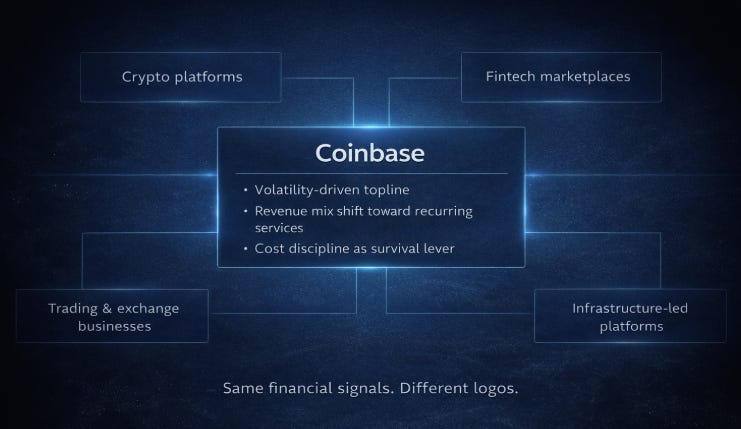
What’s most interesting here is how transferable these patterns are. Even if Coinbase isn’t an account you’re actively dissecting, the same financial signals show up across other companies in this category.
You’ll see these trends across public fintech platforms including payments, brokerages, and infrastructure providers - where activity-driven revenue, fixed platform costs, and regulatory overhead force leadership to prioritize operating leverage over pure growth.
Once you see these signals, you start noticing them everywhere:
The Strategy that Matters to Leaders
What the CFO Cares Most About
Cost discipline and unit economics by tightening pricing and incentives on low-value, high-cost activity
Revenue diversification by accelerating recurring subscription and services revenue to reduce volatility
Margin protection by prioritizing higher-margin products and managing transaction costs
Operational leverage by scaling revenue without linear headcount or expense growth
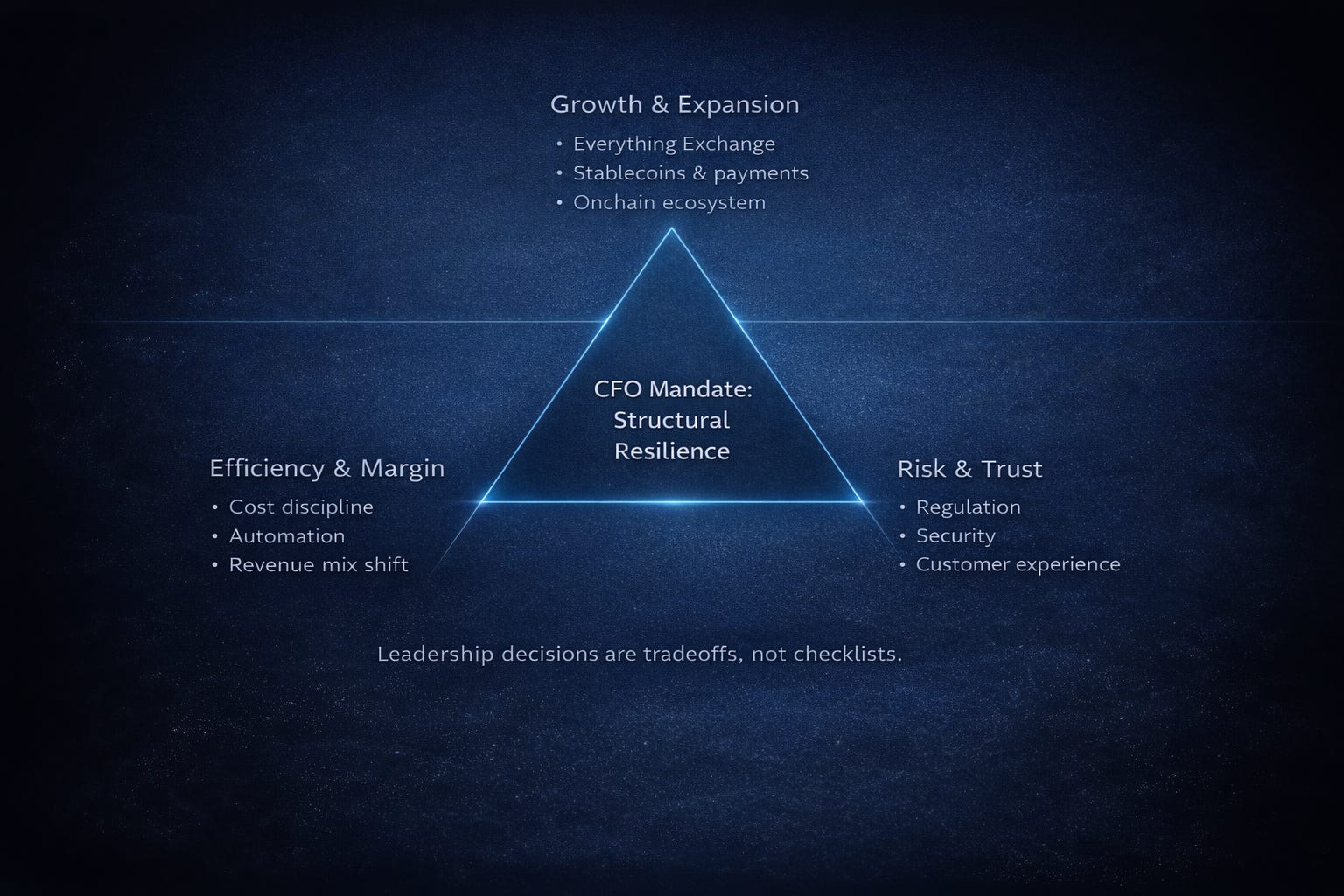
CFO Mandate:
Make Coinbase structurally more resilient by converting market volatility into operating leverage through cost discipline, margin management, and a more durable revenue mix, not by chasing volume.
What the Company Is Focused On
“Everything Exchange” expansion via stocks, ETFs, derivatives, prediction markets
Stablecoins and payments by scaling USDC to challenge traditional rails
Onchain ecosystem expansion by investing in Base and developer platforms
Institutional infrastructure by expanding custody, prime brokerage, and issuer services
Automation and AI by improving product quality and efficiency
Strategic Initiative:
Evolve Coinbase from a cyclical crypto exchange into a diversified, global financial and onchain infrastructure platform.
What’s Getting in Their Way
Regulatory and execution complexity uncertainty across asset classes
Fee compression from zero-commission trading and competitive pricing
Operational and reputational risk under heightened scrutiny
Customer experience challenges around support and account access
Market volatility with revenue still highly sensitive to trading cycles
Challenges:
Coinbase must execute a broad platform expansion and efficiency transformation while managing regulatory risk, margin pressure, and cyclical demand - without sacrificing trust or operational control.
Every strategic decision Coinbase makes is a tradeoff between growth, efficiency, and risk.
The Sales Translation
If I were selling Grafana, I’m not pitching “observability”.
I’m helping Coinbase turn platform complexity into operational leverage by giving leadership real-time control over cost, reliability, and risk without adding headcount.
Value Pillars
make cost drivers visible across infrastructure and activity
maintain reliability as volatility spikes
reduce operational risk without scaling teams
protect margins through system-level insight
support audit and compliance readiness
Example narrative:
Companies like Coinbase face margin pressure from volatility and scale in an always-on, regulated platform.As complexity increases, operational risk and cost rise faster than visibility.
Grafana restores operating leverage by giving leadership real-time control over cost, reliability, and risk as activity scales.
What company should I teardown next?
DM me or email andrew@hackingsales.xyz if you have a suggestion. Subscribers are prioritized and all details are kept anonymous.
As always, thanks for reading and see you all next week.
-Andrew K
PS - if you liked this article, feel free to give a “like”, “comment”, or “share” with your network
How are you figuring out the business engine and translating the financial reality in the takeaways? Is that guesswork or AI prompting to support you?:
Edit: as i typed this, I went back and read this: https://www.hackingsales.xyz/p/the-framework-that-turns-financials
So i guess that answers it!
"Takeaways:
Although reporting is centralized, P&L accountability lives at the customer and product level. This is most likely where budget decisions are made and where sellers should anchor their narrative.
Coinbase is highly cycle-sensitive:
Trading volatility can drive high-margin revenue, but it’s unpredictable.
Subscription and services revenue is steadier, but requires upfront investment.
Infrastructure bets are long-term ROI plays that pressure near-term margins.
Diversification helps at the platform level, but leadership is actively shifting the mix from volatile transaction revenue toward more predictable, recurring services.
Cost discipline matters here more than at most “growth” tech companies."